

Picture this: you’re halfway to Grandma’s house with the whole family in the car, holiday food in the cooler, and suddenly steam starts pouring from under the hood on I-85. Traffic’s packed with nearly 80 million Americans heading somewhere for the holidays, and now you’re stuck waiting for a tow truck while dinner gets cold. According to AAA’s latest forecast, about 79.9 million travelers will hit the road this holiday season, making it one of the busiest travel periods of the year. With that many vehicles on Atlanta’s already congested highways, the last thing you want is to become another roadside statistic because of something you could have easily prevented.
The good news? Most holiday breakdowns happen because of issues that are completely avoidable with just a little preparation. We’re talking about the components under your hood that work silently every single day until they don’t—serpentine belts, radiator hoses, and essential fluids. These aren’t flashy parts that grab your attention, but they’re absolutely critical to getting you from Stone Mountain to wherever you’re celebrating. A quick pre-trip inspection can mean the difference between smooth sailing and spending hours on the shoulder of I-285 while everyone else is celebrating.
Why “Silent” Failures Are the Biggest Risk to Your Holiday Road Trip
Here’s what makes belt and hose failures particularly nerve-wracking: they rarely give you much warning. Your brakes will squeal when the pads are wearing thin, giving you weeks to schedule service. Your battery will click weakly before it dies completely, telling you it’s time for a replacement. But serpentine belts and radiator hoses? They can look perfectly fine one minute and catastrophically fail the next, leaving you stranded without any heads-up.
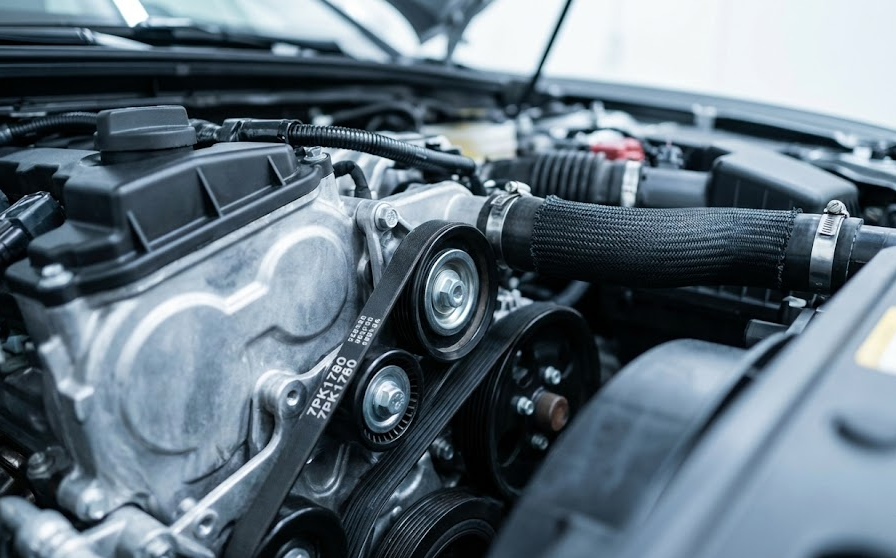
Think about how these components work. Your serpentine belt is constantly flexing thousands of times per mile as it transfers power from your engine to your alternator, power steering pump, air conditioning, and often your water pump. Meanwhile, your radiator hoses are repeatedly expanding and contracting as coolant cycles between extreme temperatures—from near-boiling when the engine’s running to cool when it’s parked. This constant stress takes a toll, and eventually the rubber degrades from the inside out where you can’t see it happening.
What makes holiday travel especially risky is the combination of factors that put maximum strain on these parts. You’re likely loading your vehicle heavier than usual with passengers, luggage, and food. You’ll probably be driving longer distances than your typical commute around Stone Mountain or trips to Atlanta. And with holiday traffic on routes like I-85 toward South Carolina or I-75 heading to Florida, you’ll spend more time idling in stop-and-go conditions where your engine runs hot and these components work overtime. According to the National Highway Traffic Safety Administration, proper vehicle preparation is essential for safe travel, especially during high-volume holiday periods when help might take longer to arrive.
The Serpentine Belt: How to Spot Dry Rot Before It Snaps
Your serpentine belt might be one continuous piece of rubber, but it’s responsible for keeping almost everything under your hood running properly. When it snaps—and eventually they all do—your alternator stops charging the battery, your power steering quits working, and depending on your vehicle, your water pump might stop circulating coolant. On a loaded holiday trip through Georgia’s winter weather, a failed belt can quickly lead to an overheated engine and potentially thousands in repair costs.
Most serpentine belts are designed to last somewhere between 60,000 and 100,000 miles under normal conditions, but “normal” doesn’t typically include the kind of sustained highway driving and heavy loads you’ll encounter on a holiday road trip. The belt needs to be visually inspected for several warning signs. You’re looking for glazing, which appears as a shiny, hardened surface instead of the matte texture of a healthy belt. This glazing means the rubber has gotten too hot and started to break down, reducing its grip on the pulleys.
Small surface cracks running across the belt aren’t always immediately dangerous, but multiple deep cracks or any cracks along the length of the belt spell trouble. You also want to watch for any fraying at the edges or chunks of material missing from the ribs. If your vehicle is approaching that 60,000-mile mark and you’re planning any significant travel, it’s genuinely worth replacing the belt proactively. During your oil change service, our technicians routinely check the serpentine belt’s condition, but before a long trip, it’s worth having us take an extra-thorough look.
Hoses and Coolant: Avoiding Overheating in Holiday Traffic
Atlanta-area traffic during the holiday weeks is already stressful enough without adding the panic of watching your temperature gauge climb into the red. Your cooling system depends entirely on those upper and lower radiator hoses to move coolant between your engine and radiator, and when one fails, you’ve got maybe a few minutes before things get serious.
Over time, your hoses go through literally thousands of heat cycles—expanding when hot coolant flows through them and contracting when the engine cools. Here’s what you should be checking: squeeze the hose gently when the engine is completely cold. A healthy hose feels firm but slightly flexible, bouncing back quickly when you release pressure. If it feels mushy or spongy, that’s internal deterioration even if the outside looks fine.
Look carefully for bulges or swelling anywhere along the hose—this indicates the internal reinforcement has failed and the hose is ballooning under pressure. You might notice small cracks in the rubber, especially near bends. Even tiny cracks can quickly become leaks under the pressure and heat of extended highway driving. And if you see any signs of dried coolant residue (often appears as greenish or orange crusty deposits), that means you’ve already got a slow leak that will likely get much worse under the stress of a long trip.
What makes coolant leaks particularly problematic during holiday travel is how quickly they can escalate. You might start with a small seep that’s barely noticeable around town, but load the vehicle up, drive for several hours at highway speeds in stop-and-go traffic on I-75, and that small leak becomes a major failure. Old coolant loses its protective properties, becoming more acidic and actually corroding your hoses, water pump, and radiator from the inside. Fresh coolant contains corrosion inhibitors and lubricants that protect your entire cooling system.
Essential Fluid Levels: The Lifeblood of Your Long-Distance Drive
Fluids are easy to overlook because unlike parts that wear out visibly, they just sit there doing their job quietly until they can’t anymore. But every fluid in your vehicle serves a critical purpose, and on a long holiday trip where you’re pushing your car harder than usual, having everything topped off with fresh fluids can prevent a whole range of problems that would otherwise ruin your holidays.
Start with engine oil, which is absolutely fundamental to everything your engine does. Clean oil lubricates all the moving parts, helps cool the engine, and prevents metal-on-metal contact that causes catastrophic damage. When you’re loaded down with passengers and luggage, climbing hills on I-85 toward Greenville or maintaining highway speeds for hours, your engine is working significantly harder than during your daily drive around DeKalb County. Old, dirty oil breaks down faster under these conditions and stops protecting your engine effectively.
Your transmission fluid is equally important but gets even less attention from most drivers. The transmission generates tremendous heat, especially in stop-and-go traffic where it’s constantly shifting. Brake fluid is one of those things people forget about until something goes wrong, but it’s hygroscopic, meaning it absorbs moisture over time. That moisture lowers the boiling point of the fluid, and during extended braking, overheated brake fluid can create vapor pockets that dramatically reduce braking effectiveness. We’ll test your brake fluid’s moisture content to ensure your braking system performs reliably throughout your journey.
Critical Components Inspection Checklist
| Component | What We Check | Warning Signs | Why It Matters |
|---|---|---|---|
| Serpentine Belt | Cracks, glazing, fraying, tension | Squealing noise, shiny surface, damage | Failure stops alternator and power steering |
| Radiator Hoses | Bulges, soft spots, cracks, clamps | Spongy feel, swelling, coolant residue | Burst causes coolant loss and overheating |
| Engine Coolant | Level, color, contamination | Low level, rusty color, oily appearance | Degraded coolant causes corrosion |
| Engine Oil | Level, color, consistency | Dark/black color, low level | Clean oil protects under highway load |
| Brake Fluid | Level, moisture content, clarity | Dark color, low level | Contaminated fluid can boil |
Frequently Asked Questions
Q: How often should serpentine belts be inspected?
A: Ideally, serpentine belts should be visually inspected at every oil change, which is typically every 5,000 to 7,500 miles depending on your vehicle and driving conditions. However, most manufacturers recommend replacement every 60,000 to 100,000 miles regardless of appearance. Before any long trip, it’s smart to have a thorough inspection, especially if your belt is approaching these mileage intervals or if your vehicle is more than four years old.
Q: What are the signs of a failing radiator hose?
A: The most telling signs include bulging or swelling anywhere along the hose, especially near the clamps where they connect to the engine or radiator. When you squeeze a cold hose gently, it should feel firm but slightly flexible—if it feels mushy, spongy, or excessively soft, the internal structure is breaking down. Look for visible cracks in the rubber, particularly near bends or areas that flex frequently. Dried coolant residue (often appearing greenish, orange, or yellowish depending on your coolant type) means you already have a leak that will worsen under pressure and heat.
Q: Can I just top off my fluids myself before the holidays?
A: While topping off fluids is better than leaving them low, it’s only a partial solution. Simply adding fresh fluid to old, degraded fluid doesn’t restore the protective properties you need. A professional flush removes all the old fluid and replaces it with fresh, properly formulated fluid that will actually protect your vehicle throughout a long, demanding trip. Plus, during professional service, we’re checking for leaks and other issues that you might miss when just adding fluid at home.
Q: Why do belts break more often during holiday travel?
A: Holiday travel creates a perfect storm of stress factors for your serpentine belt. First, you’re likely carrying more weight than usual—passengers, luggage, food, and gifts all add up, forcing your engine to work harder. Second, sustained highway driving generates more heat and requires more power from the belt-driven accessories. Third, holiday traffic means more time idling in stop-and-go conditions, which keeps the engine bay hot without the cooling airflow you get at highway speeds. All these factors together accelerate wear on a belt that might already be near the end of its service life.
Schedule Your Pre-Trip Inspection at Stone Mountain Nissan
Don’t let a broken belt or failed hose delay your holiday dinner and turn your holiday into a roadside nightmare. The factory-trained experts at Stone Mountain Nissan Service Center are here to ensure your vehicle is completely ready for the journey ahead, whether you drive a brand-new Nissan Altima or a trusted Rogue that’s been serving your family reliably for years. We have the right diagnostic tools, genuine Nissan parts, and specialized knowledge to handle every aspect of your pre-trip inspection efficiently and thoroughly.
With nearly 80 million Americans traveling this holiday season and Atlanta-area highways among the busiest in the country, waiting to address potential problems only increases your risk of becoming another roadside statistic during the worst possible time. Our comprehensive inspection approach identifies exactly what your vehicle needs, ensuring you get appropriate service that prevents breakdowns rather than just a quick once-over that misses hidden wear. We’ll check every critical component—serpentine belts, radiator hoses, coolant condition, oil quality, brake fluid, and more—giving you complete confidence that you’ll arrive safely at your destination.
Or visit us at 4275 US-78, Lilburn, GA 30047, and let our certified technicians ensure your vehicle is ready to deliver you and your family safely to wherever you’re celebrating this holiday season.